

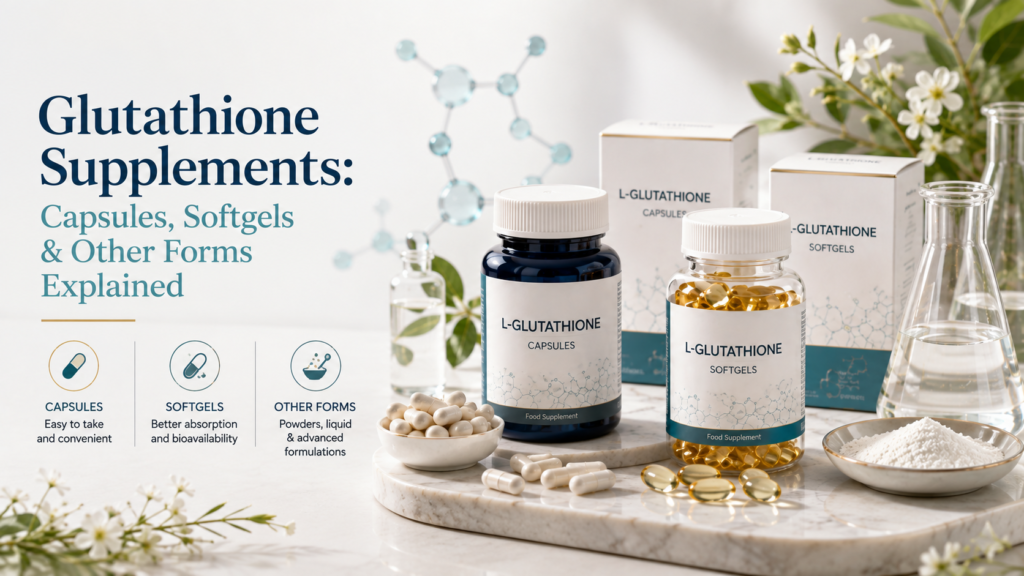
Glutathione Supplements: Capsules, Softgels & Other Forms Explained
If you’ve been researching glutathione, you’ll quickly discover that it is available in several different product formats.
You may see glutathione capsules, softgels, tablets, powders and other formulations, with some products combining glutathione with ingredients such as vitamin C or other nutrients.
So how do you compare them?
The first thing to understand is that a glutathione supplement is not defined only by the number printed on the front of the bottle. The form of glutathione, serving size, complete ingredient list, formulation, manufacturer information and intended use all matter.
This guide explains the common types of glutathione supplements, what to look for on a label and how to compare products more intelligently.
What Are Glutathione Supplements?
Glutathione supplements are products designed to provide glutathione in an oral or other supplemental form.
Glutathione itself is a naturally occurring molecule made by the body from three amino acids: glutamate, cysteine and glycine. It plays important roles in antioxidant defense and cellular processes.
The body naturally produces glutathione, but researchers have also investigated whether supplementation can increase glutathione levels under certain conditions.
A randomized controlled trial published in PubMed found that daily oral glutathione supplementation increased glutathione levels in several body compartments after longer-term use, although results can vary depending on the formulation, dose and individual. (pubmed.ncbi.nlm.nih.gov)
This is why it is useful to understand what you’re actually buying rather than treating every glutathione product as identical.
Common Types of Glutathione Supplements
1. Glutathione Capsules
Capsules are one of the most common oral formats.
A capsule generally contains the active ingredient in powder or another encapsulated formulation.
Advantages of capsules
- Convenient to take
- Easy to store
- Clearly defined serving size
- Available in different strengths
- Often combined with other nutrients
When comparing capsule products, check the amount of glutathione per serving, not just the total amount displayed prominently on the package.
2. Glutathione Softgels
Softgels are another oral format.
Unlike traditional hard capsules, softgels are typically made using a gelatin or vegetarian shell containing the product formulation inside.
Softgels can be convenient for people who prefer this type of dosage form.
However, the fact that a product is a softgel does not automatically make it more effective than a capsule.
What matters is the actual formulation, ingredient quality, dosage and evidence.
3. Glutathione Tablets
Some products are supplied as tablets.
Tablets are compressed solid dosage forms and may contain glutathione alongside other ingredients used for manufacturing and stability.
As with capsules and softgels, compare:
- Glutathione amount
- Serving size
- Other active ingredients
- Full ingredient list
- Manufacturer
- Recommended use
rather than judging the product only by its format.
4. Glutathione Powder
Powder formulations may be supplied in containers or individual sachets.
The main difference is that the consumer may need to measure or mix the powder according to the product instructions.
Check the label carefully for:
- Serving size
- Amount per serving
- Mixing instructions
- Storage requirements
- Other ingredients
A powder is not automatically better than a capsule or softgel.
Reduced Glutathione vs Other Forms
When shopping for glutathione, you may see the term reduced glutathione.
Reduced glutathione is commonly abbreviated as GSH.
Glutathione also exists in an oxidized form, known as GSSG.
These forms are part of the body’s redox system.
If a supplement label specifically states that it contains reduced glutathione, this provides more information about the form of the ingredient than simply saying “glutathione.”
However, product quality still depends on the complete formulation and manufacturing process.
What Does “L-Glutathione” Mean?
Many supplement labels use the name L-glutathione.
This can be confusing because consumers sometimes assume that “L-glutathione” and “glutathione” are completely different ingredients.
In product labeling, L-glutathione generally refers to the naturally relevant form of glutathione used in nutritional and biochemical contexts.
When comparing products, pay attention to the complete ingredient declaration rather than relying on the marketing name alone.
What Is the Difference Between Glutathione Amount and Serving Size?
This is one of the most important things to understand when comparing supplements.
Imagine two products:
Product A
500 mg glutathione per capsule
Product B
1,000 mg glutathione per serving
Serving size: 2 capsules
At first glance, Product B may appear to have a higher amount.
But Product A provides 500 mg in one capsule, while Product B provides 500 mg per capsule when the full serving is two capsules.
This is why you should always check:
Amount per serving + serving size + number of servings per container.
Don’t compare front-label numbers without checking the Supplement Facts or nutritional information panel.
Glutathione Supplements With Vitamin C
Some glutathione products include vitamin C as an additional ingredient.
Vitamin C is an essential nutrient and antioxidant that participates in numerous normal physiological processes.
Because both glutathione and vitamin C are associated with antioxidant systems, manufacturers sometimes combine them in nutritional formulations.
However, the presence of vitamin C does not automatically prove that a particular glutathione product is more effective.
Compare the actual amounts and complete formulation before making a decision.
Glutathione Supplements With Other Ingredients
Some products contain glutathione alongside ingredients such as:
- Vitamin C
- Alpha-lipoic acid
- Selenium
- Grapeseed extract
- Other botanical extracts
- Other antioxidant nutrients
A combination formula may be appropriate for some consumers, while others may prefer a simpler product containing fewer active ingredients.
There is no universal rule that a longer ingredient list means a better supplement.
The right choice depends on the product’s intended use and your individual circumstances.
How Is Oral Glutathione Absorbed?
This is one of the most frequently discussed questions about glutathione supplements.
Because glutathione is a molecule made from amino acids, researchers have investigated what happens to orally consumed glutathione during digestion and whether supplementation can meaningfully influence glutathione levels within cells.
The evidence is not completely uniform.
Some clinical research has found increased glutathione levels following oral supplementation, while other studies have reported more limited effects depending on the study design and outcome measured. (pubmed.ncbi.nlm.nih.gov)
More recent research has also examined whether different formulations can affect glutathione bioavailability.
A 2026 randomized crossover trial compared standard and micellar glutathione formulations and found differences in bioavailability, although the study was relatively small and further research is needed. (pubmed.ncbi.nlm.nih.gov)
This means that formulation can matter.
Does a Higher-Dose Glutathione Supplement Work Better?
Not necessarily.
A common mistake when shopping for supplements is assuming:
Higher number = better product.
That isn’t necessarily true.
Clinical studies have investigated different glutathione doses and formulations, and results cannot simply be extrapolated to every product.
For example, one six-month randomized controlled study investigated both 250 mg and 1,000 mg daily oral glutathione and reported changes in glutathione measures. (pubmed.ncbi.nlm.nih.gov)
This does not mean that everyone should take 1,000 mg.
A suitable serving depends on the specific product, individual circumstances and professional guidance where appropriate.
How to Choose a Glutathione Supplement
If you’re comparing several products, use this checklist.
1. Check the Glutathione Form
Look for whether the label specifies:
- Glutathione
- L-glutathione
- Reduced glutathione
- Another specified formulation
Clear labeling makes product comparison easier.
2. Check the Amount Per Serving
Don’t rely only on the number on the front of the bottle.
Check the actual serving size and amount per serving.
3. Read the Complete Ingredient List
Look at both the active ingredients and other ingredients.
This is especially important if you have allergies, dietary restrictions or sensitivities.
4. Check the Number of Capsules
A bottle containing 60 capsules is not necessarily equivalent to one containing 90 capsules.
The serving size determines how long the product may last.
For example:
60 capsules ÷ 2 capsules per serving = 30 servings.
This is more useful information than simply comparing the capsule count.
5. Check the Manufacturer Information
Look for:
- Manufacturer name
- Country of manufacture where stated
- Batch or lot information
- Expiration date
- Storage instructions
- Contact information
Clear labeling helps consumers understand the product they are purchasing.
6. Look at the Product’s Intended Use
A dietary supplement should not be confused with a cosmetic product or a professional-use formulation.
Capsules and softgels are generally marketed as oral supplements.
Topical glutathione products are cosmetic formulations.
Injectable glutathione is a separate category with different safety and administration considerations.
Glutathione Capsules vs Softgels
So which is better?
There is no simple answer.
Capsules
Pros
- Convenient
- Easy to store
- Often available in powder formulations
- Usually straightforward to compare by serving
Softgels
Pros
- Easy-to-swallow format for some people
- Can contain different formulations
- Convenient for daily use
The important point
Don’t choose a product simply because it is a capsule or softgel.
Compare the ingredient, amount, serving size, formulation, manufacturer and product quality.
Are Glutathione Supplements Safe?
The safety of a supplement depends on the ingredients, dose, formulation and individual circumstances.
A product that is appropriate for one person may not be appropriate for another.
If you’re taking medication, have a medical condition, are pregnant or breastfeeding, or have concerns about supplement use, consult an appropriate healthcare professional before starting a new product.
Also remember that supplements should not be used as substitutes for medical diagnosis or treatment.
What About Glutathione Injections?
Glutathione injections should not be treated as simply a stronger version of capsules.
An injectable product has different requirements because it bypasses the digestive system and is introduced directly into the body.
Sterility, manufacturing quality, administration technique and medical supervision are therefore particularly important.
The FDA has previously raised concerns about compounded injectable glutathione products and reported adverse events associated with excessive bacterial endotoxin in certain compounded products. (fda.gov)
Injectable products should only be administered under appropriate professional supervision and in accordance with applicable regulations.
Common Mistakes When Buying Glutathione Supplements
Mistake 1: Choosing only by milligrams
A bigger number doesn’t automatically mean better results.
Mistake 2: Ignoring serving size
Always calculate the amount per serving and the number of servings per container.
Mistake 3: Assuming every formulation is equivalent
Different formulations may have different absorption and bioavailability characteristics.
Mistake 4: Believing guaranteed-result claims
Avoid products promising guaranteed skin whitening, permanent results or dramatic health outcomes.
Mistake 5: Ignoring the complete label
Check ingredients, manufacturer details, directions and storage instructions.
Frequently Asked Questions
What are glutathione supplements?
Glutathione supplements are products designed to provide glutathione in supplemental forms such as capsules, softgels, tablets or powders.
Are glutathione capsules effective?
Some clinical studies have found that oral glutathione supplementation can increase glutathione levels under certain conditions, but results vary by formulation, dose, duration and individual factors.
What is reduced glutathione?
Reduced glutathione, commonly abbreviated as GSH, is one of the forms of glutathione involved in the body’s redox system.
Are glutathione softgels better than capsules?
Not necessarily. Capsules and softgels are different delivery formats, but neither is automatically superior. Compare the complete formulation, serving size, ingredients and manufacturer information.
What should I look for in a glutathione supplement?
Check the glutathione form, amount per serving, serving size, complete ingredient list, number of servings, manufacturer information, storage instructions and intended use.
Can glutathione supplements contain vitamin C?
Yes. Some formulations combine glutathione with vitamin C or other nutrients.
Is a higher glutathione dose always better?
No. A higher labeled amount does not automatically mean a product is more effective or suitable for everyone.
Can I take glutathione every day?
Some clinical studies have investigated daily oral glutathione supplementation. However, the appropriate use depends on the specific product and individual circumstances. Follow the product label and seek professional advice when appropriate.
Are capsules and injections the same?
No. They have different routes of administration and different safety considerations. Injectable glutathione should only be used under appropriate professional supervision.
How do I compare two glutathione products?
Compare the form of glutathione, amount per serving, serving size, number of servings, additional ingredients, manufacturer information and intended use rather than looking only at the front-label strength.
Final Thoughts
Glutathione supplements come in many forms, and choosing between them doesn’t have to be complicated.
Start with the basics:
What form is it?
How much is in each serving?
What other ingredients are included?
Who makes it?
What is it intended for?
Capsules, softgels, tablets and powders can all be convenient formats, but the dosage form alone doesn’t determine product quality.
If you’re comparing glutathione products, read the complete label and look for clear, accurate product information rather than relying on exaggerated claims.
For products with specific medical or professional-use requirements, consult an appropriate healthcare professional before use.