

Reduced Glutathione vs Glutathione: What’s the Difference?
If you’ve ever compared glutathione supplements, you may have noticed terms such as glutathione, reduced glutathione, L-glutathione, GSH and oxidized glutathione on different product labels.
At first, these names can be confusing.
Is reduced glutathione different from glutathione? Is L-glutathione another ingredient? And does a product labeled “reduced glutathione” automatically mean it is better?
The short answer is that reduced glutathione is one specific form of glutathione. Understanding the relationship between these terms makes it much easier to read supplement labels and compare products accurately.
What Is Glutathione?
Glutathione is a naturally occurring molecule found in cells throughout the body.
It is made from three amino acids:
- Glutamate
- Cysteine
- Glycine
Glutathione participates in antioxidant defense, cellular redox regulation and several other biochemical processes.
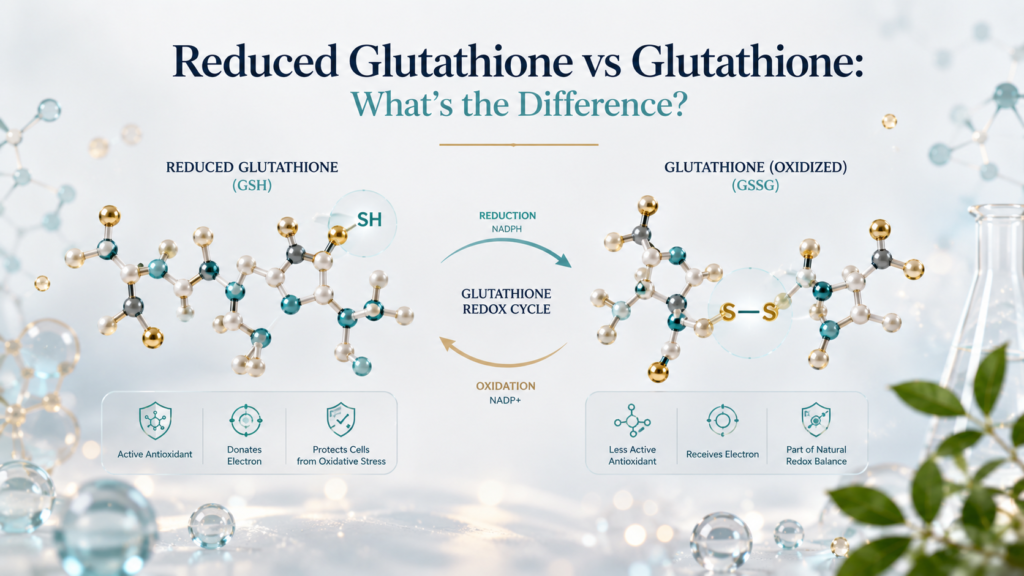
It exists within a system that includes different chemical forms, with reduced glutathione (GSH) and oxidized glutathione (GSSG) being the two forms most commonly discussed.
The National Library of Medicine describes glutathione as a tripeptide involved in cellular redox processes and antioxidant activity. NCBI — Glutathione
What Is Reduced Glutathione?
Reduced glutathione is commonly abbreviated as GSH.
The word “reduced” describes the chemical state of the glutathione molecule.
In simple terms, GSH has an available sulfhydryl group that allows it to participate in redox reactions.
This is an important part of glutathione’s biological role.
When you see a supplement labeled:
Reduced Glutathione
the manufacturer is specifying the particular chemical form of glutathione used in the product.
Is Reduced Glutathione the Same as Glutathione?
Reduced glutathione is glutathione, but the term “glutathione” by itself does not always specify the chemical form.
Think of it this way:
Glutathione
→ the overall molecule/system being discussed
Reduced glutathione (GSH)
→ one chemical form of glutathione
Oxidized glutathione (GSSG)
→ another chemical form
This is why product labels can look different even when they are referring to related ingredients.
What Does GSH Mean?
GSH is the commonly used abbreviation for reduced glutathione.
You may see GSH mentioned in:
- Scientific studies
- Research papers
- Supplement ingredient information
- Laboratory discussions
- Biochemistry resources
If a supplement says it contains GSH, it is referring to reduced glutathione.
What Is Oxidized Glutathione?
When reduced glutathione participates in certain oxidation-reduction reactions, it can form oxidized glutathione, commonly abbreviated as GSSG.
The relationship can be represented simply as:
GSH ⇄ GSSG
This reversible relationship is part of the cellular redox system.
The body maintains a balance between reduced and oxidized forms, and the ratio between them is often used in scientific research as an indicator of cellular redox conditions.
This doesn’t mean that GSSG is “bad” and GSH is “good.”
Both are part of the glutathione system.
Reduced Glutathione vs Oxidized Glutathione
Here’s the simplest comparison:
| Feature | Reduced Glutathione | Oxidized Glutathione |
|---|---|---|
| Abbreviation | GSH | GSSG |
| Chemical state | Reduced | Oxidized |
| Role | Participates in antioxidant/redox reactions | Product formed during oxidation reactions |
| Naturally occurring | Yes | Yes |
| Part of glutathione system | Yes | Yes |
The two forms are chemically connected and participate in the body’s redox system.
Why Does the Reduced Form Matter?
Reduced glutathione is important because of its ability to participate in redox reactions.
It can interact with reactive molecules and participate in the regeneration of other antioxidant systems.
This is one reason glutathione is often described as an important cellular antioxidant.
The National Institutes of Health explains that glutathione is involved in antioxidant and immune-related processes. NIH Office of Dietary Supplements
However, it’s important not to turn this biological function into an exaggerated supplement claim.
The fact that GSH has an important role in the body does not automatically mean that taking a GSH supplement produces a specific health or cosmetic result.
What Is L-Glutathione?
Another term you may see is L-glutathione.
This can sometimes create confusion because shoppers may think L-glutathione and reduced glutathione are completely different substances.
In product and biochemical contexts, “L-glutathione” generally refers to glutathione using the naturally relevant L-configuration of its amino acid components.
However, the term L-glutathione does not by itself tell you whether a product is specifically describing the reduced or oxidized state.
For that, look at the complete ingredient declaration.
If the label specifically states:
Reduced L-Glutathione
then the manufacturer is identifying both the glutathione configuration and its reduced chemical state.
Why Do Supplement Labels Use Different Names?
There are several reasons.
Manufacturers may use different terminology depending on:
- Ingredient specification
- Formulation
- Regulatory labeling requirements
- Marketing terminology
- Country of sale
- Product format
For example, one product may say:
L-Glutathione
while another says:
Reduced Glutathione
and another may simply say:
Glutathione
These names should not automatically be interpreted as completely different ingredients.
The full ingredient panel provides more useful information than the front of the package alone.
Does Reduced Glutathione Mean Better?
Not necessarily.
This is an important point.
You may see products marketed around phrases such as:
“100% Reduced Glutathione”
or
“Premium Reduced GSH”
but the word reduced alone doesn’t tell you whether a particular supplement is the best choice for you.
When comparing products, look at:
- Actual glutathione form
- Amount per serving
- Serving size
- Other ingredients
- Product formulation
- Manufacturer
- Storage instructions
- Product quality
- Intended use
A product with a clear and accurate label is easier to evaluate than one relying primarily on marketing language.
Reduced Glutathione in Supplements
Reduced glutathione is commonly used in oral supplement formulations.
You may find it in:
- Capsules
- Tablets
- Softgels
- Powders
- Combination supplements
Some products combine glutathione with ingredients such as vitamin C, selenium, grapeseed extract or other nutrients.
The presence of additional ingredients doesn’t automatically mean a product is better.
It is more useful to understand what each product contains and how it is intended to be used.
For more information about comparing different supplement formats, read our Glutathione Supplements: Capsules, Softgels & Other Forms Explained article.
Does the Form Affect Absorption?
This is an area where formulation becomes important.
Oral glutathione passes through the digestive system, and researchers have investigated how much orally consumed glutathione becomes available within the body.
Clinical research has produced different findings.
One randomized controlled study found that longer-term oral glutathione supplementation increased glutathione levels in several compartments of healthy adults. PubMed — Oral Glutathione Randomized Controlled Trial
Other research has produced more limited results depending on the duration and biomarkers studied.
More recent research is also investigating specialized formulations designed to change glutathione bioavailability.
A 2026 randomized crossover study compared standard and micellar glutathione and reported differences in bioavailability, although the study was small and additional research is needed. PubMed — Glutathione Bioavailability Study
This means that simply knowing a product contains “reduced glutathione” isn’t enough to predict its overall performance.
How to Read a Glutathione Supplement Label
If you’re shopping for a glutathione supplement, use this checklist.
1. Look for the Exact Ingredient Name
Check whether the label states:
- Glutathione
- Reduced glutathione
- L-glutathione
- Another specified form
Don’t rely solely on the product title.
2. Check the Amount Per Serving
A bottle may say:
1,000 mg
but you need to determine whether that means:
- 1,000 mg per capsule
- 1,000 mg per serving
- 1,000 mg across multiple capsules
Always check the serving-size panel.
3. Check the Number of Servings
A 60-capsule bottle isn’t necessarily a 60-day supply.
For example:
60 capsules ÷ 2 capsules per serving = 30 servings.
This is why serving size matters.
4. Review Other Ingredients
Check whether the product also contains:
- Vitamin C
- Selenium
- Botanical extracts
- Other antioxidant ingredients
- Capsule materials
- Excipients
This is particularly important for people with allergies or dietary restrictions.
5. Check Storage Requirements
Some supplement ingredients can be sensitive to heat, moisture or light.
Follow the storage instructions printed on the actual product packaging.
Does Reduced Glutathione Have Skin Benefits?
Glutathione has been studied for potential effects on skin pigmentation and appearance, which is why it appears in many beauty-focused products.
However, this area requires careful interpretation.
A systematic review of clinical studies found some evidence that oral and topical glutathione may influence skin pigmentation, but also highlighted limitations in the available evidence. PubMed — Glutathione and Skin Pigmentation Review
Therefore, it would be inaccurate to say:
“Reduced glutathione permanently whitens skin.”
A more scientifically responsible statement is:
Glutathione has been studied for potential effects on skin pigmentation, but clinical evidence remains limited and results can vary.
This distinction is especially important when evaluating products marketed for skin brightening.
Is Reduced Glutathione the Same as a Glutathione Injection?
No.
The ingredient may be related, but the route of administration is completely different.
An oral capsule and an injectable formulation should not be treated as interchangeable products.
Injectable formulations involve additional considerations such as:
- Sterility
- Manufacturing quality
- Administration
- Storage
- Professional supervision
- Applicable regulations
The FDA has previously raised safety concerns regarding certain compounded injectable glutathione products. FDA — Injectable Glutathione Safety Information
Injectable products should therefore only be administered under appropriate professional supervision.
Common Questions About Reduced Glutathione
Is reduced glutathione the same as GSH?
Yes. GSH is the common abbreviation for reduced glutathione.
Is reduced glutathione better than regular glutathione?
The word “reduced” identifies a chemical state of glutathione. It does not automatically mean that every reduced-glutathione supplement is better than every other product.
What does GSSG mean?
GSSG is the common abbreviation for oxidized glutathione.
What does L-glutathione mean?
L-glutathione refers to glutathione containing the naturally relevant L-configuration of its amino acid components. Check the complete label to determine the specific form stated by the manufacturer.
Which form of glutathione should I buy?
There is no universal answer. Compare the ingredient form, amount per serving, complete formulation, manufacturer information and intended use.
Does reduced glutathione help skin?
Glutathione has been studied in relation to skin pigmentation, but evidence is limited and does not establish guaranteed or permanent skin-lightening results.
Are reduced glutathione capsules safe?
Safety depends on the specific product, ingredients, serving and individual circumstances. Follow the product directions and consult an appropriate healthcare professional if you have concerns.
Can I take reduced glutathione every day?
Some clinical studies have investigated daily oral glutathione supplementation. However, use should follow the manufacturer’s directions and individual professional advice where appropriate.
Final Thoughts
The difference between glutathione, reduced glutathione and oxidized glutathione becomes much easier to understand once you know that they describe related forms within the glutathione system.
The key points are:
- Glutathione is the overall molecule being discussed.
- Reduced glutathione (GSH) is one chemical form.
- Oxidized glutathione (GSSG) is another form.
- L-glutathione describes the relevant molecular configuration used in biochemical and product terminology.
- Product quality cannot be judged by one label term alone.
When comparing glutathione supplements, look at the complete ingredient declaration, serving size, formulation, manufacturer information and intended use.
For more information, explore our Glutathione Supplements collection or read our guides on What Is Glutathione? and Glutathione Benefits.